Investing
-
Most Investors Get Systematic Option Collar Wrong
Investors often mistake an options collar for an absolute safety net, assuming it provides full downside immunity while maintaining unconstrained upside potential. In this historical simulation over an eleven-year span,…
-
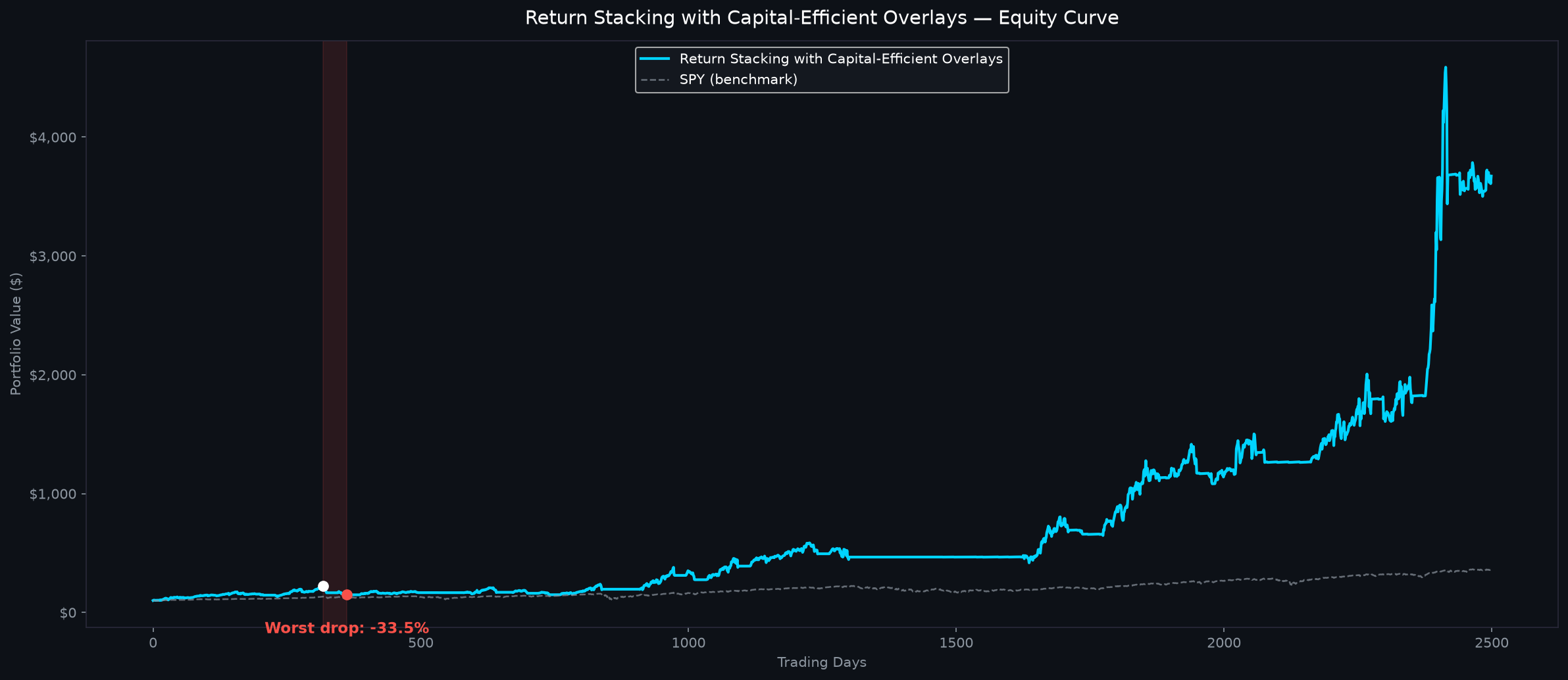
Return Stacking with Capital-Efficient Overlays Turned $10,000 → $367,554 (Full Backtest)
In an 11-year historical simulation, a hypothetical $10,000 stake compounded at a 43.7% annualized rate (Sharpe 1.18) into more than $367,500, vastly outpacing the broad market benchmark. However, capturing those…
-
Most Investors Get Realized Skewness Lottery Demand Strategy Wrong
Many investors assume chasing crypto lottery demand is purely reckless gambling, but systematic screening can harvest extreme upside while disciplining downside exposure. Over an 8-year historical simulation, the strategy produced…
-
Can The Golden Cross Tactical Overlay Beat the S&P 500? I Ran the Numbers
In historical simulation across the backtested period, the Golden Cross Tactical Overlay achieved an 8.3% CAGR, a -4.8% maximum drawdown, and a 1.05 Sharpe ratio, trading away upside against the…
-
I Backtested Same-Weekday Return Continuation — Here’s What Happened
Turning calendar rhythms into a systematic trading edge sounds appealing, but capturing steady annualized gains required enduring steep drops along the journey. Based on historical simulation, this high-risk strategy generated…
-
Most Investors Get Quarter-Hour Microstructure Flow Wrong
Investors frequently assume that trading high-frequency crypto momentum provides a low-risk alternative to broader market exposure by keeping holding durations short. In reality, capturing intraday microstructure flow demands enduring steep…
-
Canary-Signaled Tactical ETF Strategy Turned $10,000 → $15,458 (Full Backtest)
A $10,000 stake run through this rule as a historical simulation would have finished near $15,460, while the same money parked in SPY would have finished near $41,180. The rule…
-
I Backtested The Nocturnal Equity Drift — Here’s What Happened
Capturing stock market gains exclusively while the exchange is closed offers surprisingly strong growth, but avoiding daytime trading hours does not eliminate downside pain. In backtests, holding leveraged index funds…
-
Can Liquidation-Cascade Intraday Mean Reversion Beat the S&P 500? I Ran the Numbers
Liquidation-cascade mean reversion aims to capture rapid intraday bounces by stepping in only after forced leveraged liquidations exhaust selling pressure across major crypto pairs. While holding pure cash during unfavorable…
-
Can Dealer Gamma Hedging Congruence Beat the S&P 500? I Ran the Numbers
This historical simulation examines the Dealer Gamma Hedging Congruence model, trading off absolute growth for severe capital preservation across twenty liquid crypto tokens. By tethering capital to Bitcoin trend filters…
-
Most Investors Get The Fifty-Two Week High Leaderboard Wrong
Investors often assume that momentum strategies tracking 52-week highs in leveraged instruments guarantee benchmark outperformance, but compounding decay and defensive exit lag frequently erode those gains. In this historical simulation,…
-
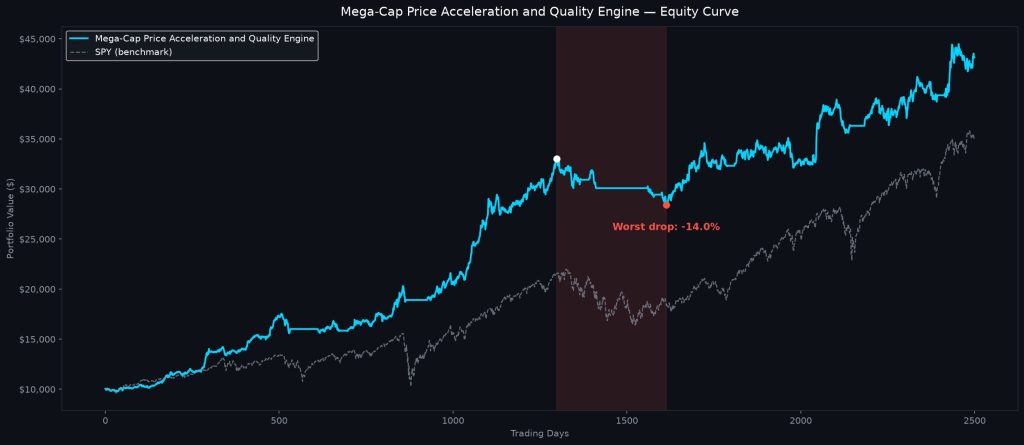
Most Investors Get Mega-Cap Price Acceleration and Quality Engine Wrong
Investors often assume capturing momentum requires enduring punishing market drawdowns, yet aggressive growth strategies can be stabilized through systematic trend rules. Inspired by the Driehaus growth framework, this model pairs…